Injuries Caused by Manual Handling
External and internal injuries, and the main musculoskeletal disorders caused by poor manual handling — muscular strain, torn ligaments and tendons, cartilage damage, hernias, prolapsed discs and sciatica.
What this part covers
- External and internal injuries
- Muscular strain
- Torn ligaments and tendons
- Cartilage damage
- Hernias
- Prolapsed discs and sciatica
Manual handling can injure both the handler and the person being handled, and it helps to think in terms of two broad categories.
External injuries
Cuts, bruises, crush injuries and lacerations to fingers, hands, forearms, ankles and feet. These are usually less serious than internal injuries, though still very real.
Internal injuries
These give rise to musculoskeletal disorders — problems affecting the body's muscles, joints, tendons, ligaments and nerves. Severity ranges from minor aches through to serious, lasting conditions. Musculoskeletal disorders most often affect the back, neck, shoulders and upper limbs, though the lower limbs aren't immune either — repetitive strain injury from repeated or awkward manual handling is a good example.
The rest of this part walks through the main musculoskeletal disorders you're likely to encounter.
Carrying a load places pronounced static strain on several muscle groups, particularly in the arms and trunk. Contracted muscles compress the blood vessels running through them, restricting the flow of oxygen and glucose the muscle needs — tiredness sets in quickly, and pain often follows, especially in the back.
Muscular strain is typically caused by a combination of high force loads, excessive repetition, and awkward posture — often all three together.
Torn ligaments
Ligaments are fibrous bands connecting two bones at a joint — flexible, but inelastic. They limit a joint's range of movement, but can't stretch once taut. Force a joint beyond its normal range and the ligament tears — that's a sprain. Fibrous tissue heals slowly, and a severe sprain can be just as disabling as a broken bone.
Tendons
Tendons are similar fibrous bands, but they connect muscle to bone rather than bone to bone, and are built to withstand tension rather than limit movement. Tendon and muscle work as a pair and can only exert a pulling force. Injuries usually show up as inflammation, gradual weakening, and — if left unaddressed — eventual rupture.
Cartilage is a flexible tissue found in joints — the elbow, knee, ankle and the vertebrae, among others. It's less rigid than bone but stiffer than muscle. Unlike most tissue, cartilage has no blood supply of its own, which is exactly why it heals so slowly once damaged.
A hernia is when an organ pushes through from one compartment of the body into another — for example, a bent-back lifting stance can force a loop of intestine into the groin or through the front abdominal wall. If the intestine becomes strangled, blood supply can be cut off, which is potentially life-threatening.
Hernias are commonly caused by heavy lifting or anything that raises abdominal pressure. Most give no symptoms at all, though some people feel discomfort or pain, particularly when standing, straining or lifting something heavy.
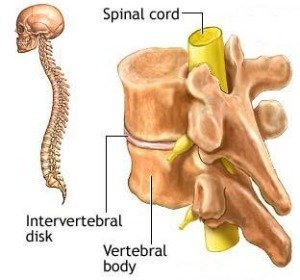
Prolapsed discs
Between the spine's 33 vertebrae sit gristle-like discs that act as shock absorbers, protecting the spine. A "prolapsed" or slipped disc happens when one of these discs is displaced or compressed from its normal position — commonly caused by lifting with a bent back. It can be genuinely painful, and in severe cases can lead to partial paralysis.
Sciatica
Sciatica describes pain, weakness, numbness or tingling caused by pinching or irritation of the sciatic nerve, which runs down each leg from the lower back. It isn't a condition in itself, but a symptom of something else — often a slipped disc or a pelvic injury. Some people feel sharp pain in one part of the leg, hip or foot alongside numbness elsewhere; the pain often builds gradually rather than appearing all at once.