The Law & Risk Assessment
The Manual Handling Operations Regulations 1992, employer and employee duties, and the TILE(O) framework for assessing and reducing the risk of injury.
What this part covers
- The Manual Handling Operations Regulations 1992
- Avoiding, assessing and reducing risk
- The TILE(O) risk assessment framework
- Safe systems of work and algorithms
Concerned about the cost of manual handling injuries, the Secretary of State used powers under the Health and Safety at Work etc. Act 1974 to establish the Manual Handling Operations Regulations 1992 (amended in 2002). The HSE administers these regulations on the Secretary of State's behalf, and they apply to both employed and self-employed workers, regardless of occupation.
The regulations place legal duties on employers and employees alike (a self-employed person is responsible as both). Other laws relevant to manual handling are covered later in this course.
Employers' duties break down into three headings, which must all be met "so far as is reasonably practicable" — meaning risk should be reduced until any further precaution's cost, in time, effort or money, would be disproportionate to the benefit gained.
- Avoid the need for hazardous manual handling wherever possible
- Assess the risk of injury from any hazardous handling that can't be avoided
- Reduce the risk of injury from hazardous handling that remains
- Follow the systems of work their employer sets out
- Use equipment appropriately and safely
- Cooperate with the employer's health and safety policy
- Report hazardous handling activities they identify
- Take care that their own actions don't put others at risk
Avoiding manual handling
The law requires employers to first consider whether manual handling can be avoided altogether — could the treatment come to the patient instead, or is there lifting equipment that could be used instead of a person?
Assessing the risk
If avoiding the handling isn't reasonably practicable, the law requires a risk assessment. This is the employer's responsibility — in a larger organisation, a trained assessor typically does this, though a self-employed person must carry it out themselves, and a lone worker facing a new, urgent situation can conduct their own assessment on the spot. A written record should generally be kept unless the assessment can be repeated and explained at any time; one assessment can cover several employees doing the same task, though individuals with additional needs or vulnerabilities may need their own; and assessments must be revised whenever the task changes or improvements are made.
The HSE recommends five things be considered in every manual handling risk assessment — Task, Individual capability, Load, Environment and Other factors — commonly shortened to the acronym TILE(O). A dated form recording the task, place and people involved is a useful way to log your observations.
Before any manual handling, work through four objectives in order: try to avoid the risk, assess any potential risk, reduce the risk, then review it regularly.
Task — does it involve...?
- Holding something away from the body, reaching upwards, or stooping
- Strenuous pushing, pulling, twisting or sudden movements
- Repetitive effort, little rest, or a work rate dictated by a process
- Large vertical movements or long carrying distances
Individual capability — does the job...?
- Endanger a pregnant worker, someone with a health condition, or a disabled worker
- Need unusual strength, height or agility, or special training or information
Load — is it...?
- Heavy, bulky, unwieldy, hard to grasp, or awkwardly stacked
- Hard to see over, sharp, or hot
- Unstable or likely to move unpredictably (people or animals fall into this category), or hazardous in some other way
Environment — are there...?
- Constraints on posture, from tight spaces or restrictive protective clothing
- Uneven, slippery, unstable or variable-level floors
- Hot, cold, humid or poorly ventilated conditions, or poor lighting
Other factors to weigh up
- Is the work boring, or are deadlines unreasonably tight?
- Is communication between workers and management poor?
- Is the equipment right for the job, well maintained, with handles between waist and shoulder height, and wheels and brakes that work properly?
A wide range of aids can make an operation safer, too — handling belts for walking transfers, slide sheets for patients lying down, or swivel seats for getting in and out of a car.
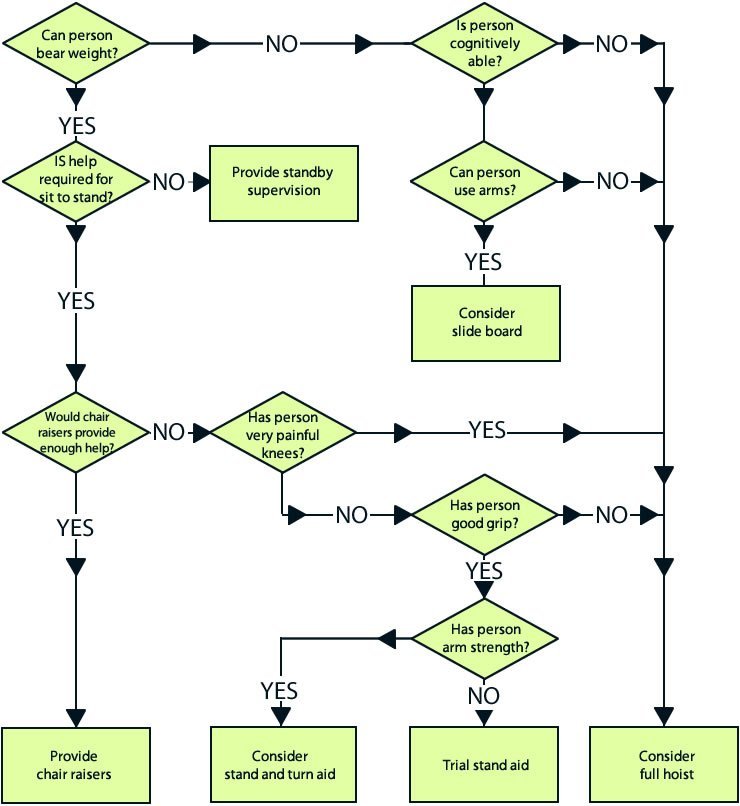
Two different assessors can reach different conclusions about the same task, and reducing risk in one area can sometimes create a problem elsewhere. To build a genuinely safe system of work, an assessor should know current best practice and its limitations, consult peers, be willing to admit when a solution isn't working, fully understand both the task and the person being helped, stay flexible about different options, know what equipment and help is available, think about the wider impact of any change, and measure, record and review what's actually happening.
To help less experienced handlers reach a sound decision, algorithms — flow diagrams built from a series of questions and answers — are often used to guide someone toward the right method for a given situation, as shown above.