Biomechanics & Safe Lifting Technique
How levers and forces act on your spine when lifting, the biomechanical principles of safe lifting, recommended lifting limits, pushing and pulling loads, and team manual handling.
What this part covers
- Biomechanics and levers
- Forces on the back
- Your environment
- Biomechanical principles of safe lifting
- Recommended lifting limits
- Pushing and pulling loads
- Team manual handling
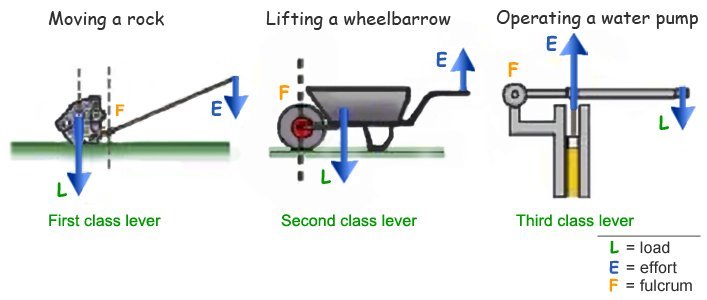
Biomechanics is the relationship between the body's movements and the forces acting on the musculoskeletal system — and understanding it is the foundation for safe lifting and moving technique.
It helps to first recognise the three classes of mechanical lever, since the body's own musculoskeletal system operates on exactly the same principles, using bones as levers, joints as pivots, and muscles to provide the compensating force.
Alongside any load it lifts or moves, the body also has to bear its own weight. The greater the load, and the further it sits from the relevant pivot point, the greater the compensating effort your muscles need to produce — and the greater the compressive force on that pivot.
The back works as a first-class lever: a load held in the arms or hands is balanced by the back muscles, with the resulting compressive force acting through the vertebrae of the spine.
When lifting an inanimate object, choose the shortest route with the least side-to-side movement — it's kinder to your body. Even a slight twist under load puts extreme stress on the joints as your body pushes against the object's resistance.
Your environment can work against you: stairs, slopes and corners all make carrying harder, and so-called "unnatural" barriers — uncovered wires, loose rugs or carpet, unsteady steps, faulty stepladders — add just as much risk. There are two ways to deal with this: take the easiest available path, avoiding stairs and tight corners, or clear the barriers out of the way first — often the simpler of the two options. Either way, take the time to do a preparatory check before you lift.
Following these steps significantly cuts your risk of injury during any lifting or moving task.
- Think and plan. Could a handling aid help? Prepare where the load is going, remove obstructions from your path, and consider a resting point if the distance is long.
- Lift only what you can manage. What you can lift and what you can safely lift aren't always the same thing.
- Warn others that you're about to move a load, so they can stay clear or offer help.
- Adopt a stable position. Feet apart, one slightly forward if the load is on the ground, feet free to move.
- Get a good hold. Hugging the load close to your body usually beats gripping tightly with just your hands.
- Keep a good posture. Don't flex your back further once you're lifting; avoid twisting or leaning sideways, especially while bent; face the load; keep your head up and look ahead, not down; start the lift with a slight bend of the back, hips and knees rather than a full squat or bend.
- Keep the load close to the waist for as long as possible, heaviest side nearest your body — sliding it closer first if needed.
- Move smoothly. Jerky movements are harder to control and raise the risk of injury.
- Put down, then adjust — slide the load into its final position after it's already down, rather than trying to fine-tune it mid-lift.
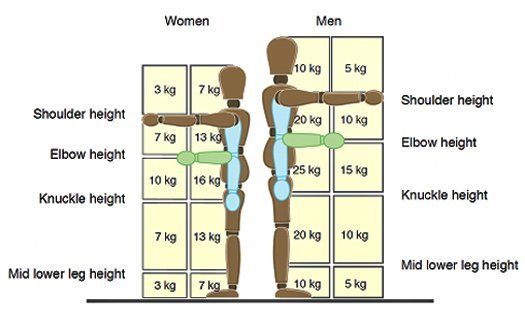
The HSE's guidelines set out lifting limits by zone, based on how close to the body and how high or low the lift takes place — each zone carries its own guideline weight, and women's guideline weights are set lower than men's. Before lifting, work out which zones your hands will pass through; the maximum safe weight is the lowest figure among all the zones involved.
Reduce the maximum weight by up to 20% if you're twisting to the side while lifting, and by up to 80% if the pace of work is faster than one lift every two minutes. These guideline limits should be reduced further still if any of the TILE(O) factors from Part 3 apply to the task at hand.
Wheeled equipment should have handles set between shoulder and waist height, run smoothly, and have large-diameter castors. Where visibility and control allow, pushing a load is generally better than pulling it.
The force needed to move a load changes a lot depending on the surface:
- Flat surface: around 2% of the load's weight with a well-maintained wheeled aid — roughly 2 kg of force to move someone in a wheelchair weighing 100 kg total.
- Sloped surface: considerably more — a gentle 1-in-12 slope raises that same 100 kg wheelchair to about 7.5% of its weight, or 7.5 kg of force.
- Rough or uneven surfaces: increase the required force further still.
The starting force needed to get a load moving from rest can itself be considerable, especially on slopes or poor surfaces — and you should always ask for help the moment you experience, or anticipate, difficulty pushing or pulling.
Using two or more people opens up operations that wouldn't be possible alone, and spreads the risk of injury. As a rule of thumb, a two-person team's combined capability is only around two-thirds of their individual capabilities added together, and a three-person team's is only around half — teamwork doesn't scale as neatly as it might seem.
- Team members should have broadly similar physical build and capability
- One person should clearly be in charge
- Agree the method and route before you start lifting
- On a slope or staircase, the person at the lower end takes most of the weight, further reducing the team's overall capability
- Team members can obstruct each other's sight or movement, and poor handholds or background noise can make coordination harder
- If a person is being carried, keep them informed throughout about what's happening